Summary:
Previously, requests were passed to process first in an interceptor, and it is responsibility of an interceptor to process requests for responses. In FlipperOkhttpInterceptor, we did read data from request body before processing it. This caused a bug when the network process itself wants to also read that data, but the stream has been closed because the interceptor has just read. The fix is to report request body after we have triggered network call so that we can just drop request body if we cannot read.

This diff tries to bring back the same functionality while not cause the bug to occur by cloning the content to be read by Flipper and using the same one for the request.

Reviewed By: jknoxville

Differential Revision: D21279679

fbshipit-source-id: 47f8b29a1896705d8d2d601661cd485db572d251
Summary:
Original Issue: https://github.com/facebook/flipper/issues/993

The exception occurs when OkHttp and we try to read request body twice, while it can be only read once.

Hence, we will read request body after it is processed by OkHttp.

Tradeoff for this is requests on Flipper will not appear immediately after fired, but they will appear together with their responses.

There are ways we can get rid of the tradeoff. For example, as demonstrated in D21167308, OkHttp ^3.14.0 contains method `isOneShot`, which can be used to check if we can read request body more than once. Another example is to change server side to accept nullable variable so that we can send request body and others separately.

Reviewed By: passy

Differential Revision: D21175341

fbshipit-source-id: 053789a2c2f28cd8149ea1bb36fd0cfe1c668df7
Summary: Flipper should never crash the mobile app. This is a plugin entry point, so it's understandable that it can, but we should avoid it whenever possible.

Reviewed By: passy

Differential Revision: D20648373

fbshipit-source-id: f32b428cccdd0c78eb15e9e95a64ecf3f4e10429
Summary:
This is the change made by Pascal at D19813495. to clean up the file

Shouldn't really change how it works but makes it
safer and brings it in line with our coding standards.

Reviewed By: passy

Differential Revision: D20474258

fbshipit-source-id: 67d77316a5b7efd7258072b4f35a2d9c50de408e
Summary:
Add logic on client side
# How it works (from the code)
1. Server side sends request url and method to response data and headers to client side
1.1. This will happen every time server update **any** mock response (add, edit, and remove)
2. Client stores those in map
3. For every network request,
3.1. Check if there is a matching url and method
3.2. If so, create a new response with the data and headers and drop the request
3.3. If not, proceed and send the request and wait for a response
`addNetworkInterceptor` is changed to `addInterceptor` to allow short-circuit and proceed without fetching anything. More info can be found at https://square.github.io/okhttp/interceptors/
Note:
- This is an original PR.
- The content below is from original PR
Add network response mocking for Network plugin. See discussion [here](https://github.com/facebook/flipper/issues/475)
## Changelog
- Add Network response mocking, currently support Android clients only
- Change the Android example app to use `addInterceptor()` instead of `addNetworkInterceptor()`
Pull Request resolved: https://github.com/facebook/flipper/pull/488
Test Plan:
{F231673798}
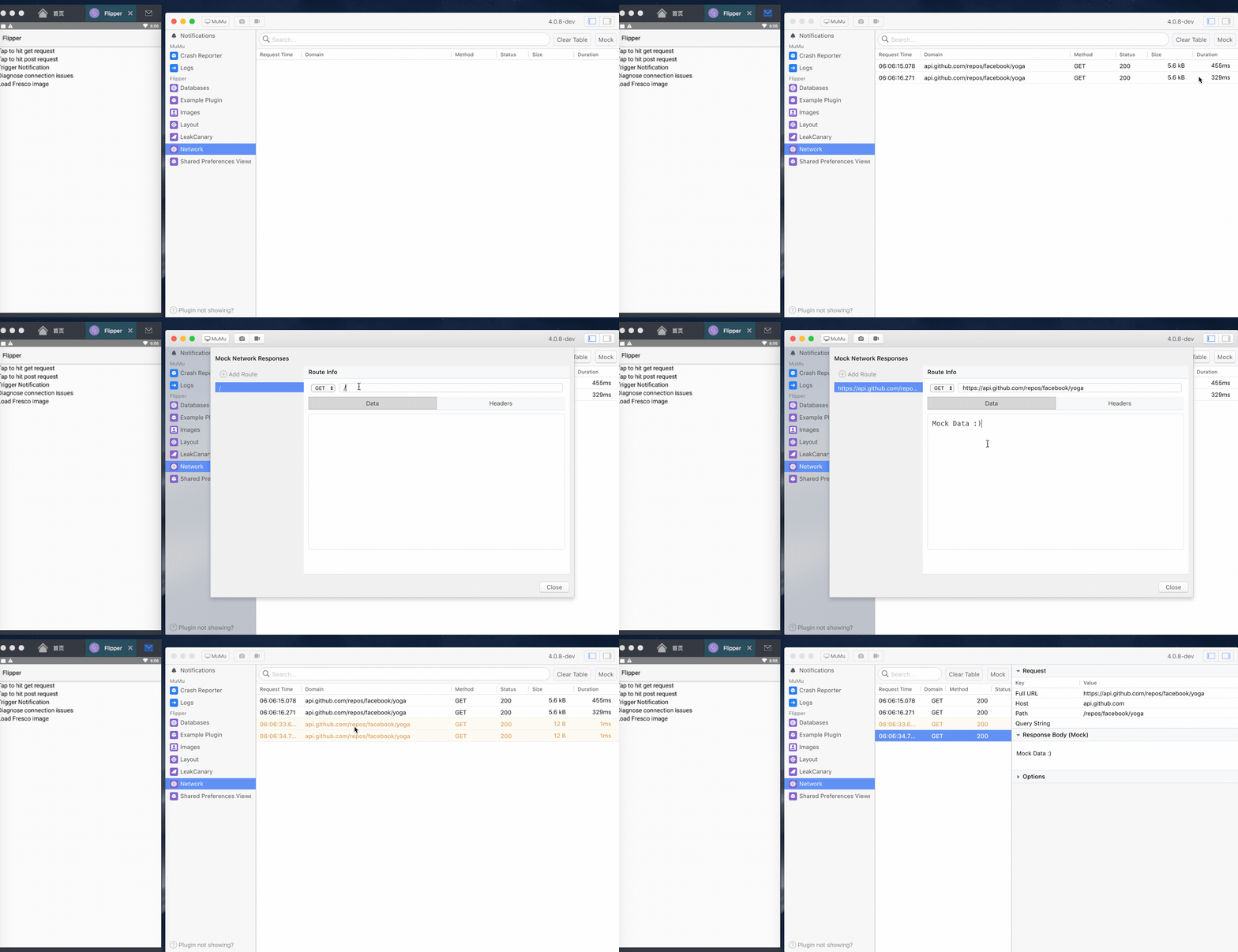
- Connect an Android device
- Tap on Network plugin
- Click on the Mock button
- Click on Add Route button, and specify the URL
- Edit the mock data in the text area
- Optionally, click the Headers tab to edit the headers data
- Click close button to close the dialog
- Send some network data in your application. You should be able to see the mock data appears in the Network table in those rows highlighted in yellow
Reviewed By: passy
Differential Revision: D16580291
Pulled By: cekkaewnumchai
fbshipit-source-id: fc391f5e7efebc6f51a72b00d16263e009e1fdb0
Summary:
per title

Note:
- This is a part of this PR: https://github.com/facebook/flipper/pull/488

Reviewed By: jknoxville

Differential Revision: D20474257

fbshipit-source-id: d2ac79d03ac67453bd67ecc46ace973be1590c04
Summary:
As previously reported in https://github.com/facebook/flipper/issues/457, I immediately started to see crashes with Flipper integrated due to large responses (e.g., >= 100MB). This will only write the first 100KB of the response or request body into `RequestInfo` objects.

## Changelog

- Limits request/response body in network request info to 100KB max.
Pull Request resolved: https://github.com/facebook/flipper/pull/617

Test Plan:
- Make a network request which has a response size of < 100kb, verify that it is visible in its entirety
- Make a network request w/ response size > 100kb, verify that it is truncated
- Ideally, use your application with the Network plugin running, and do not see OOMs

Reviewed By: mweststrate

Differential Revision: D19412075

Pulled By: passy

fbshipit-source-id: c93662dba7a5f24820287e56e889576b5bcb5a72
Summary:
Base64 encoding can easily cause OOMs for large payloads.

In the long-term, it would be great to have a way of streaming these
responses so we don't allocate 50MB chunks of memory at once.

Reviewed By: jknoxville

Differential Revision: D17951353

fbshipit-source-id: a5d7b8242892518590ac95c1d9751f24d20dc40e
Summary:
Setting up the necessary metadata to publish the separate plugins
to Maven/Bintray.

Reviewed By: danielbuechele

Differential Revision: D17480263

fbshipit-source-id: 1772cee5b3744ce52fc6e2510a27cb7f500e72bf
Summary:
This is a big one. Moves all oss plugins to a new place and leaves
stub targets in place. No logic changes. Everything apart from
BUCK files should be unchanged.

Reviewed By: jknoxville

Differential Revision: D8951045

fbshipit-source-id: 8054fb4028181d5cc4a240b1908dab6471cf0a27


